Modernism Week Tour of Royal Hawaiian Estates – Palm Springs

IMG_2486

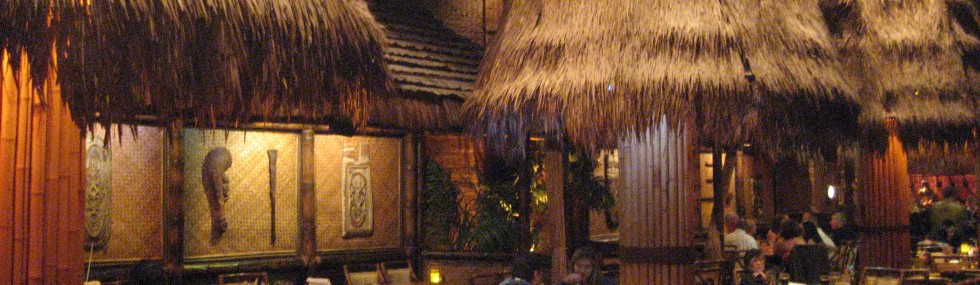
We had a great time last year at Palm Springs Modernism Week, but I was even more compelled to come back this year when I found out there would be a tour of Royal Hawaiian Estates, a 1960s condominium community that merged mid-century modern architecture with a Polynesian theme. It’s mentioned in Sven Kirsten’s book Tiki Modern, but I really took notice of it after seeing Bosko’s painting at The Book of Tiki 10th anniversary art show.

IMG_2492

Borrowing its name from the famous Honolulu hotel, Royal Hawaiian Estates was initially intended as a Jewish retirement community. It was designed by the architectural firm of Richard Harrison and Donald Wexler (the latter made a special guest appearance the day of the tour). The five-acre complex is made up of 12 buildings, divided into 40 units, surrounding two pools where Moai bask in the desert sunshine.

IMG_2496

After checking in at the front, we were given a map with self-guided tour information that highlighted unique architectural elements like the “tiki apex,” the orange flourish at the end of the center beam, and the parallel lines that flank it. These were once all over the property, but as they deteriorated in the 1990s they were removed rather than replaced.

IMG_2532

In 2010, the Royal Hawaiian Estates HOA used grants from the Palm Springs Preservation Foundation to commission a new tiki apex prototype from o2 Architecture, who designed one with low-maintenance sheet metal instead of wood. Several of these have already been put in place, and our tour fees raised enough funds to restore the remaining 30 that are missing.

IMG_2523

Another signature are the “Flying 7s,” these triangular buttresses supporting the patio roofs. They’re said to have been inspired by the lateral supports on an outrigger canoe.

IMG_2516

Several homeowners graciously opened their doors to us so we could also appreciate the interior designs, with their vaulted ceilings, clerestory windows, exposed beams and open layouts.

IMG_2506

Some units have been remodeled over the years, but others like this one here still had many original 1960 features, like terrazo floors and this shoji screen divider between the kitchen and living room.

IMG_2546

It was also interesting to see how each owner put their own personal stamp on their home, whether it was through collections of vintage barware, Heywood-Wakefield furniture or tiki mugs. (Not surprising as liking tiki often goes along with having an interest in things mid-century.)

IMG_2564

One of the units was literally a time capsule. Even though new owners had recently purchased it, they had kept nearly all the original furnishings, including the lush shag carpet, vinyl couches and vintage artwork.

IMG_2569

We were really blown away by all the different outrageously patterned wallpapers, which were still in surprisingly good condition. My favorite was the green bamboo in the guest bedroom — it’s a difficult thing to pull off, but I think they did.

IMG_2604
Admiration for Royal Hawaiian Estates was apparent in many of the owners we talked to, particularly this other couple who had on their wall an enlarged version of the original marketing brochure from 1961 (as seen in Tiki Modern.)

IMG_2580
I took many more photos than I could include here, so head over to Flickr if you’d like to see more. To really get in the mid-century mood, listen to the playlists on the Royal Hawaiian Estates web site, inspired by the music that used to be played at the pool area 24 hours a day.

Related Posts:
Modernism Week 2012 – Mid-Century Mermaids Lecture
Modernism Week 2012 – Architecture Bus Tour
Modernism Week 2012 – Vintage Airstream Trailers
5 Fascinating Facts About the “Kon-Tiki” Film

Kon-Tiki © Hanway Films/Nordisk Film Distribusjon
Image © Hanway Films/Nordisk Film Distribusjon

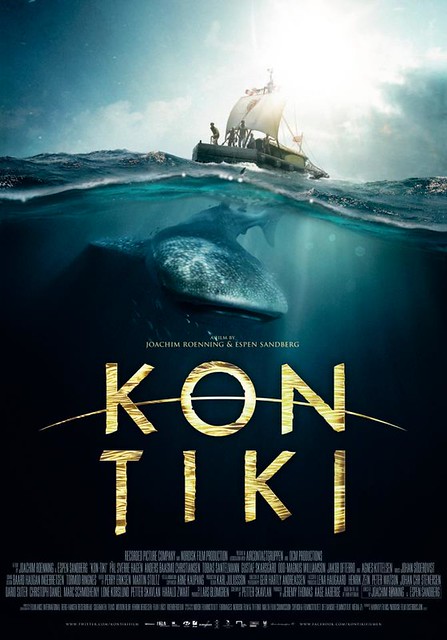
For months I’d been looking forward to a movie about a man named Thor — and I’m not talking about “The Avengers.” Norwegian explorer Thor Heyerdahl became world-famous in 1947 after he and a five-man crew constructed a primitive raft called Kon-Tiki and floated it all the way from Peru to Polynesia. This was not simply a thrill-seeking stunt, but a demonstration of his theory that the ancient Polynesians could have migrated via ocean currents from South America. His subsequent bestselling book, The Kon-Tiki Expedition by Raft Across the South Sea, and documentary helped to spark an interest in Polynesia, contributing to the mid-century craze for tiki bars.

Directors Espen Sandberg and Joachim Rønning © Nordisk Film

Fast forward several decades and now there is a new “Kon-Tiki” film, a dramatic adaptation directed by Espen Sandberg and Joachim Rønning. Released in 2012, it’s the most expensive film Norway has ever made, though the $16 million budget is still less than 10 percent of the cost for a film like “Life of Pi.” I jumped at the chance to see a preview screening of “Kon-Tiki” followed by a Q&A with the directors, screenwriter Petter Skavlan and actor Jakob Oftebro. They shared some fascinating stories about the production, and I’ve selected five of my favorite facts about this beautiful, intense and exciting film.

Pål Sverre Valheim Hagen in Kon-Tiki © Nordisk Film
Pål Sverre Valheim Hagen as Thor Heyerdahl in Kon-Tiki © Nordisk Film

1) Writer Petter Skavlan had experience in sailing across oceans, which he said helped him capture the dynamic of people at sea for an extended time. It also gained him some cred with Thor Heyerdahl, with whom he worked on developing the story. The adventurer passed away in 2002, but he had signed off on the 21-page outline for the film.

Anders Baasmo Christiansen and Pål Sverre Valheim Hagen in Kon-Tiki © Nordisk Film
Pål Sverre Valheim Hagen and Anders Baasmo Christiansen in Kon-Tiki © Nordisk

2) It is common movie magic for cities to stand in for others, but I thought it was funny that hardly any of the sites where the real events took place were used as filming locations. Rather, 1940s New York was a set in Bulgaria, Peru was actually Malta, and even some of the Norway scenes were instead shot in Sweden.

Anders Baasmo Christiansen, Gustaf Skarsgård, Pål Sverre Valheim Hagen, Jakob Oftebro, Odd Magnus Williamson and Tobias Santelmann in Kon-Tiki © Nordisk Film
Kon-Tiki © Nordisk Film

3) We viewed the original version with Norwegian dialogue, but during filming they also did identical takes in English so the movie could have a wider release internationally. The Weinstein Company acquired the rights to distribute the film in the U.S. (and a few other countries), and the English language version opens in America on April 26, 2013.

Kon-Tiki © Nordisk Film

4) In 2006, Heyerdahl’s grandson Olav was part of a crew that retraced the Kon-Tiki expedition on a newly constructed, similar raft called Tangaroa. And it was this very vessel that was used to re-create the Kon-Tiki in the film — fascinating to think that the raft you see actually made that same voyage. (Some day I hope to visit the original Kon-Tiki at The Kon-Tiki Museum in Oslo.)

Jakob Oftebro and Tobias Santelmann in Kon-Tiki © Nordisk Film

5) Joking that it’s a bit hard to tame sharks and crabs, they said the only real animal that appeared in the movie was the parrot. The others were part of the 500 or so special effect shots, which were so well done that you can’t even tell they’re CG animated.

Kon-Tiki © Hanway Films/Nordisk Film Distribusjon

“Kon-Tiki” is nominated for Best Foreign Language Film at the Academy Awards, which is fitting as Thor Heyerdahl’s 1950 documentary “Kon-Tiki” won for Best Documentary — the only Oscar awarded to a Norwegian film thus far. I think you know who I’ll be rooting for this Sunday!

Related Posts:
Kon-Tiki Printed Dress from Anthropologie
“DVD of Tiki” Screening at the Egyptian Theatre
“South Pacific” Musical at the Ahmanson Theater

D23 Presents Treasures of the Walt Disney Archives

IMG_2357

For the past several months, The Ronald Reagan Presidential Library & Museum in Simi Valley has been hosting Treasures of the Walt Disney Archives, presented by D23. This exhibition is truly a must-visit for any Disney geek and it runs through April 30, 2013.

IMG_2333

For me, one of the most exciting displays was the three prop storybooks that open at the beginning of “Sleeping Beauty,” “Snow White” and “Cinderella” to introduce each of the films. They’re so iconic, it was a thrill to see them in person.

IMG_2347

Also impressive was the re-creation of Walt’s formal office at the Burbank studios, including his actual desk and personal items like Norman Rockwell sketches of his daughters.

IMG_2348

According to the information card, songwriter Richard Sherman — co-composer of “The Tiki Tiki Tiki Room” with his brother Robert B. Sherman — would often play “Feed the Birds” (Walt’s favorite song from “Mary Poppins”) at that customized baby grand piano.

IMG_2349

Speaking of “Mary Poppins,” this traveling costume from the movie was featured in a section dedicated to Disney’s early live-action filmmaking. Apparently you can spot openings near the pockets where piano wires were attached to her suspension harness for the flying scenes.

IMG_2355

And then around the corner I was delighted to find the magician’s case of The Great Emelius Browne, along with the spell book, “Isle of Naboombu” book and bedknob from “Bedknobs and Broomsticks.” (If you can’t make it out there to see this all for yourself, there’s a photo tour online of the entire exhibit.)

IMG_2397

A giant area downstairs presented props and costumes from more recent projects like “Alice in Wonderland,” “Tron,” “The Avengers” and “Pirates of the Caribbean,” such as this 23-foot-long special effects filming model of The Black Pearl.

IMG_2375

There were also things from the Disney theme parks, like the giant Maleficent dragon head originally used in Fantasmic, which caused a bit of a stir on our local streets and highways when it was transported to the museum.

IMG_6759

So what does all this have to do with tiki? Well, it was this automaton singing bird (manufactured by Bontems in France in the early 1900s) that inspired Walt to develop Audio-Animatronics, and the first attraction to feature that innovation was… the Enchanted Tiki Room. I actually first saw this item at the Walt Disney Archives at the Burbank studios, which are not open to the public unless you’re on a special tour. This temporary exhibit is a rare opportunity to see this interesting piece of tiki-related history.

Related Posts:
Enchanted Tiki Room at Disneyland
Sketches of Enchanted Tiki Room’s Jose at Disney Gallery
Article on Enchanted Tiki Room Imagineer Rolly Crump